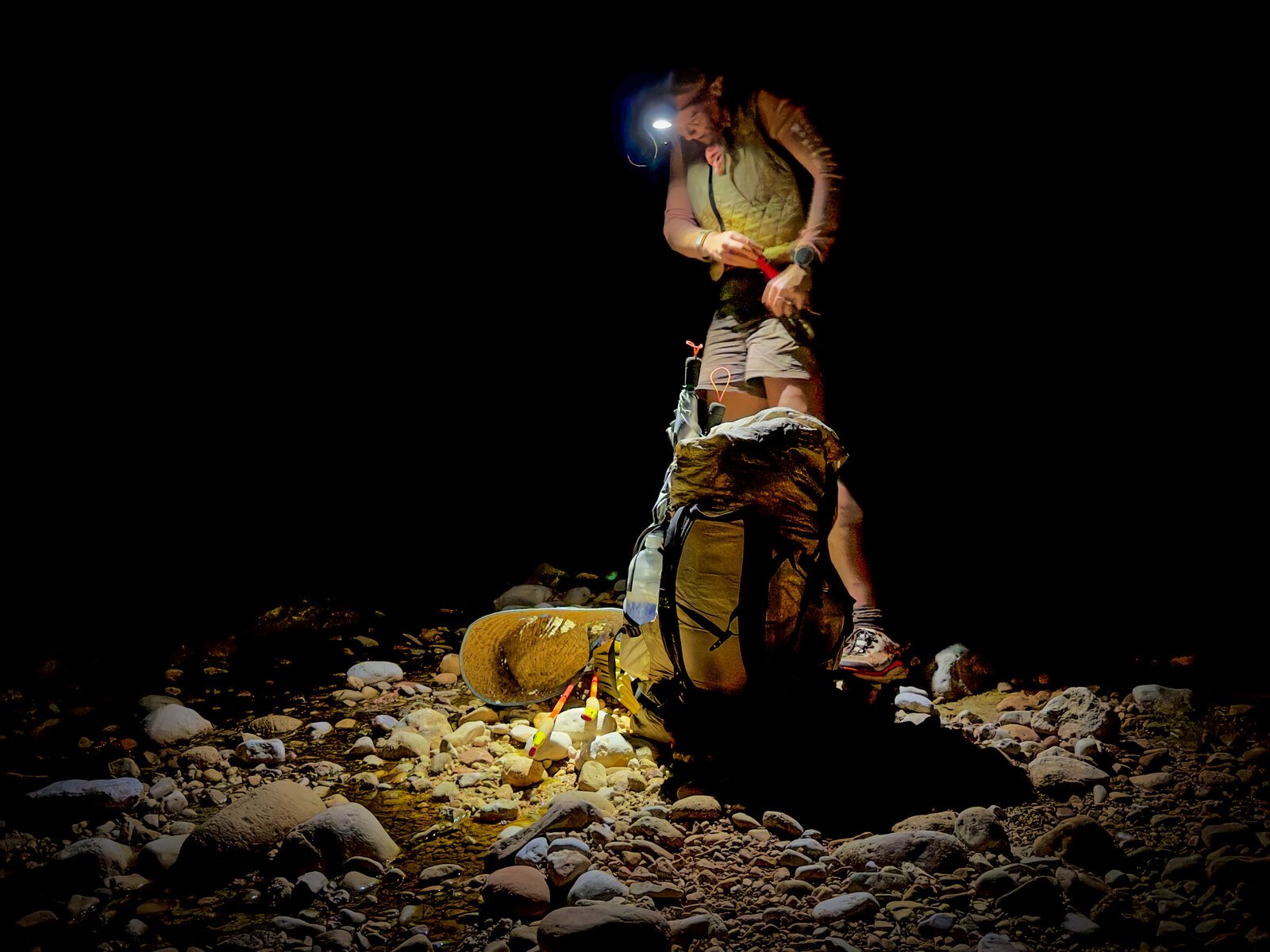
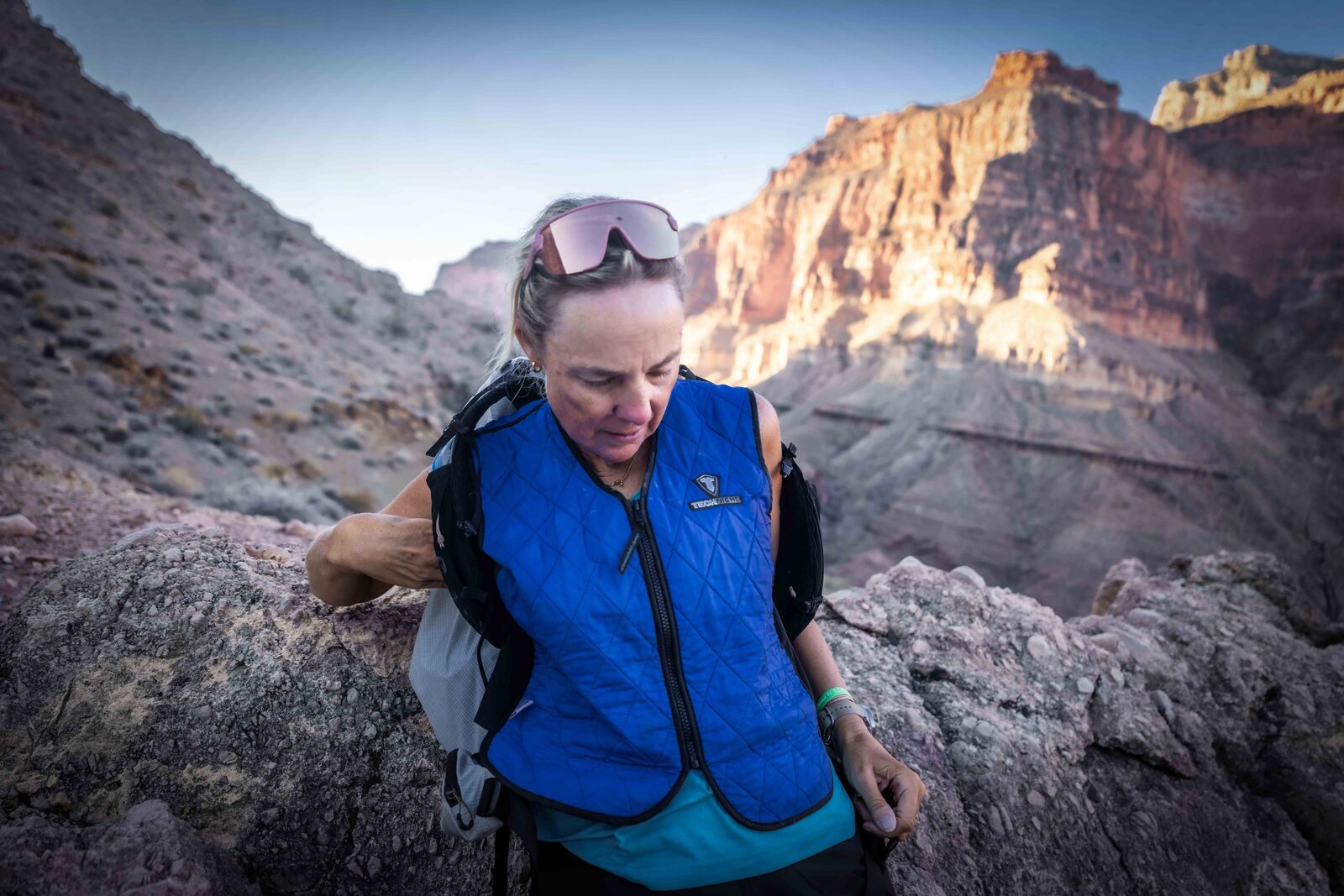
It is barely past midnight at the bottom of the Grand Canyon, and I am putting on a cooling vest.
The air temperature will reach 115° Fahrenheit today. The radiant temperature — what your body actually experiences, sandwiched between rock walls that have been banking heat for months — will push 150° to 160°. Right now, in the dark, it is somewhere in the high 80°s and almost pleasant. Nobody is excessively hot. We're sweating, but nobody is dangerously uncomfortable. And that is exactly why the vest goes on now, and why we will be walking within the hour: with this kind of heat, by the time you feel it, you are already behind in managing your exposure to it.
I wrote recently about the two kinds of risk in my world, and I'll repeat the short version because it's the foundation for everything that follows. Acute risk is the famous kind: you blow a move on a climb and you hit the ground; you misread a line on skis and you end the day in a hospital. Split-second, binary, unforgiving — and, truthfully, the easier kind to manage. You either take the risk or you don't. Your training holds or it doesn't, and you find out immediately.
Strategic risk is different. It's heat, it's cold, it's remoteness. It's the kind of risk where nothing about hour one will hurt you; the danger compounds slowly, and by the time it announces itself you are already deep in the hole. There isn't a single moment you can point to and say: that's where it went wrong.
Everybody trains for the first kind. Almost nobody thinks clearly about the second. This is a piece about the second.
The rules that felt like overkill
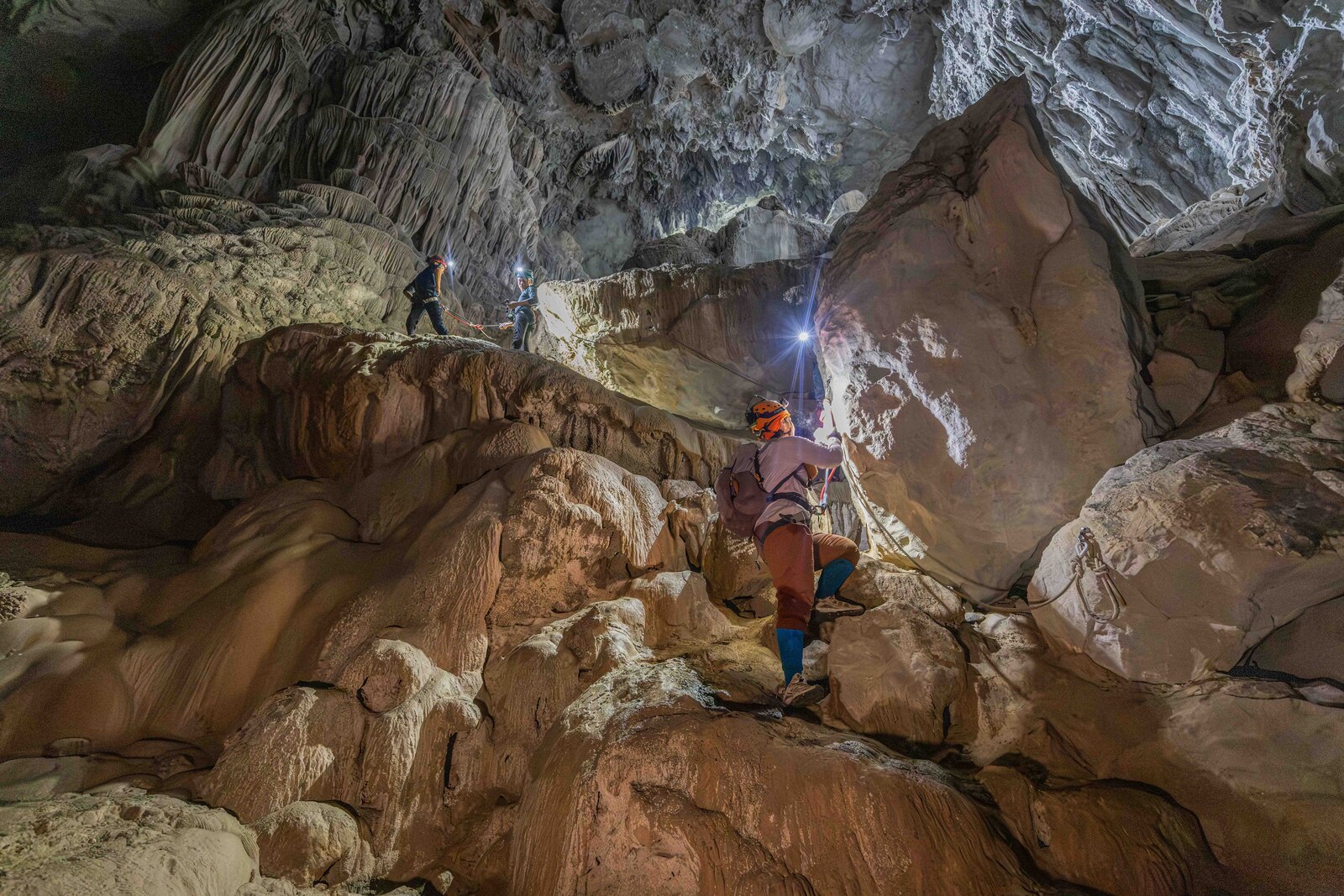
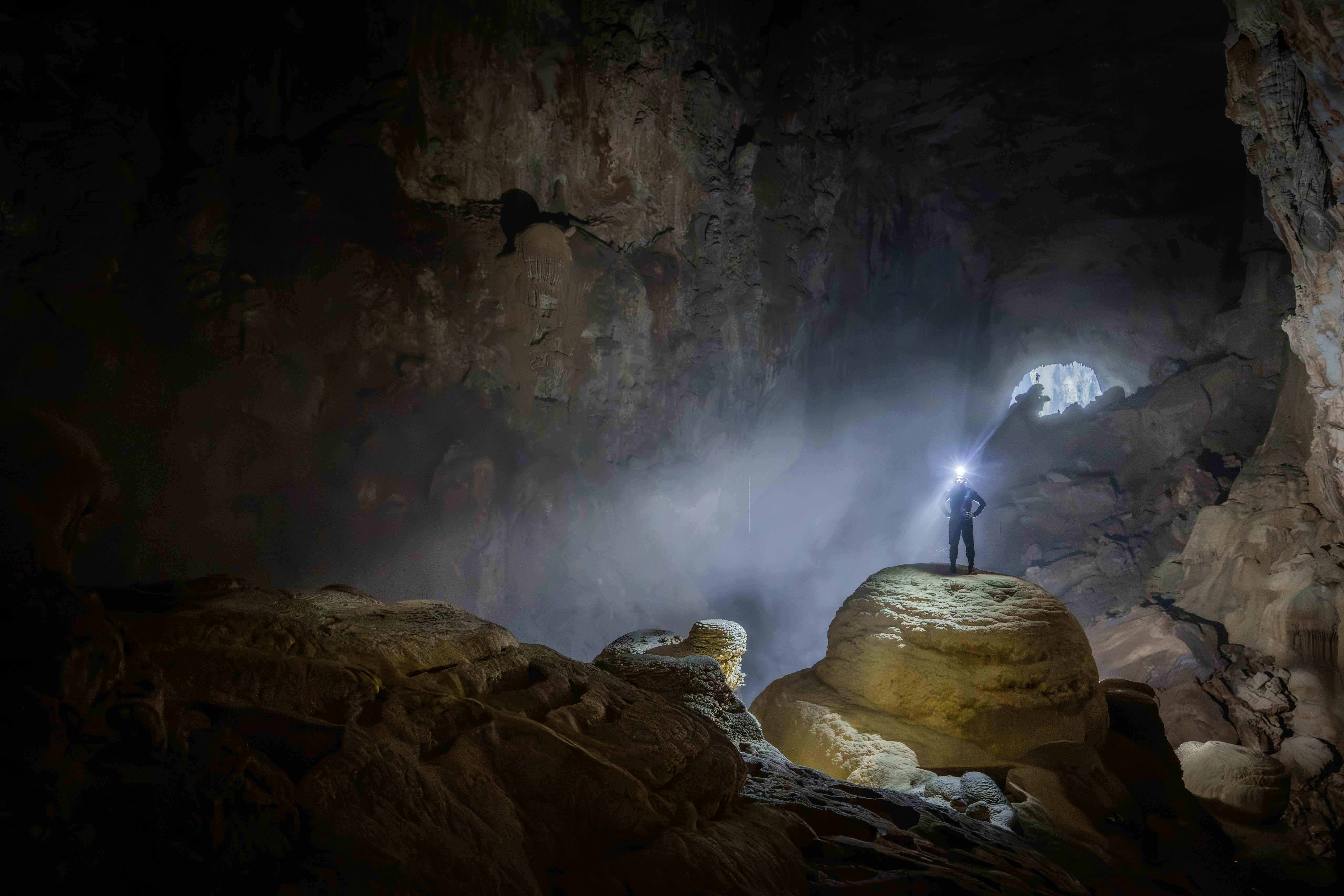
In July 2026, my husband Paul and I were in Vietnam for an expedition through Hang Son Doong — the largest cave in the world, deep in the jungle of Phong Nha. Ten guests, twenty-six porters, guides, and staff; four days of trekking, three nights camped underground in two different caves, one of them nearly 9 kilometers long. Sharp limestone, slick with humidity. There were a few steep sections on fixed ropes and hand lines, plus engaging bouldery terrain – complex, yes, but nothing extreme by the standards of anyone who climbs.
And yet the operator, Oxalis, ran the trip under a blanket of rules that initially felt comical. No jumping off anything. No swimming outside sanctioned spots. No balancing on rocks for photos. No yoga poses (yes, really — this rule exists because people kept attempting handstands on wet limestone). Caving lights on anytime we were in an overhead environment and moving around, even when there was — in my opinion — ample twilight to guide us. A guide or assistant guide posted at every awkward step to offer a hand you didn't ask for. My inner alpinist bristled the whole first day. Come on. We're adults. We can move ourselves through terrain.
So were the rules overkill?
They were not — and here is why. From the heart of the cave system, the nearest road is two days of walking away. Helicopter rescue is not something you can count on in this corner of Vietnam — it is barely something that exists. So an evacuation from deep inside Son Doong — even for something as pedestrian as a sprained ankle — means dozens of people hand-carrying a litter across the same sharp, slick, technical ground for days. Oxalis is not pricing the probability of an accident, which is low. They are pricing the cost of recovery, which is enormous. Once I saw the rules through that lens, they stopped looking like overkill and started looking like the whole point.
That reframe — judging precautions by the cost of recovery rather than the likelihood of the incident — is the first thing most people get wrong about strategic risk.
The band
Here is how I actually think about it, in the Grand Canyon, on the sea ice in the Bering Sea, anywhere.
Imagine your body — or your team, or your company — as a system with a redline at 100%. In the front country, close to roads and resources, you can brush 100%. You can even spike past it. It's not pleasant, but help is nearby: you can stop, cool down, rehydrate, call someone, and interventions will bring you back into orange and eventually the green. The redline is survivable because recovery is cheap.
In the backcountry, the math inverts. When you are the only rescue you have, you can never go above 85, maybe 90 percent — because the trip back down to green runs entirely on your own remaining reserves. If you hit 100% out there, the resources you'd need to recover are the very resources you've already spent. The load keeps compounding whether you acknowledge it or not.
This is a hard sell, because at 85% you typically feel fine. It's not that bad yet. Things feel like they're totally fine for you to simply "tough it out" for a bit. And with acute risk, toughing it out is sometimes a real strategy. But with cumulative load and strategic risk, it is not a strategy at all — there is no toughing out heat that builds by the minute, no toughing out cold at fifty below. You cannot out-suffer arithmetic. You can only get ahead of it.
Which brings me back to the cooling vest at midnight.
The catechism
In July/August 2026 I joined Mina Guli — 55 years old, mid-way through a 2,000-mile source-to-sea run down the Colorado River — for the crux of her entire campaign: the Grand Canyon in peak summer. We would end up spending eight days below the rim, in late July and early August, while the rim itself sat under an extreme heat warning. Nearly everyone who knows that terrain used the same word: impossible and a death mission, at least in summer. There were friendly brands that didn't want their logo on Mina's campaign because they were worried she would die in this section.
My job was safety, and I was nervous going in — and I'll be specific about why. I was confident we could survive any single day. What I could not know in advance — especially partnering with someone I'd never shared hard terrain with — was whether we'd reach the river each evening with enough left in the tank, or whether we'd arrive so strung out that the next day would start in the hole and the day after that would be unjustifiable. Cumulative load doesn't just span hours. It spans days.
So the planning ran on a catechism of ugly questions. What happens if we're still in exposed terrain at peak heat because we're moving slower than intended? (We were, more than once.) What happens if we have to hunker down and sit out the middle of the day? What happens if someone turns an ankle and can't move at all? What happens if I go for help — and the answer to that one was brutal: I don't. In that heat, at those distances, leaving to fetch resources meant stranding Mina without support and, literally (!), cooking myself in the attempt. In 115 degrees there's no room for dig-deep heroics — you'll dig yourself straight into death from heat stroke. So whatever we needed to survive the worst case, we had to be carrying.
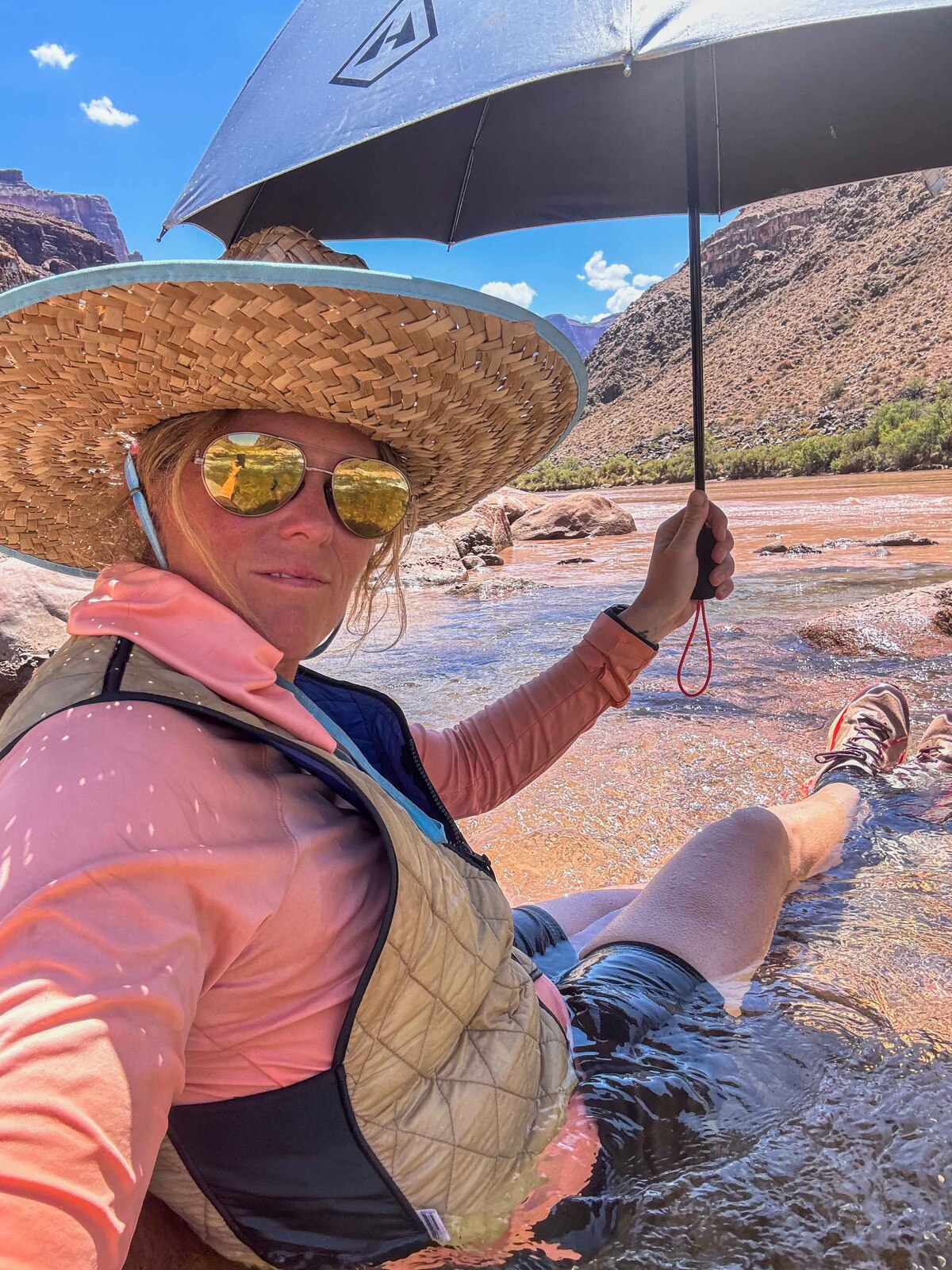
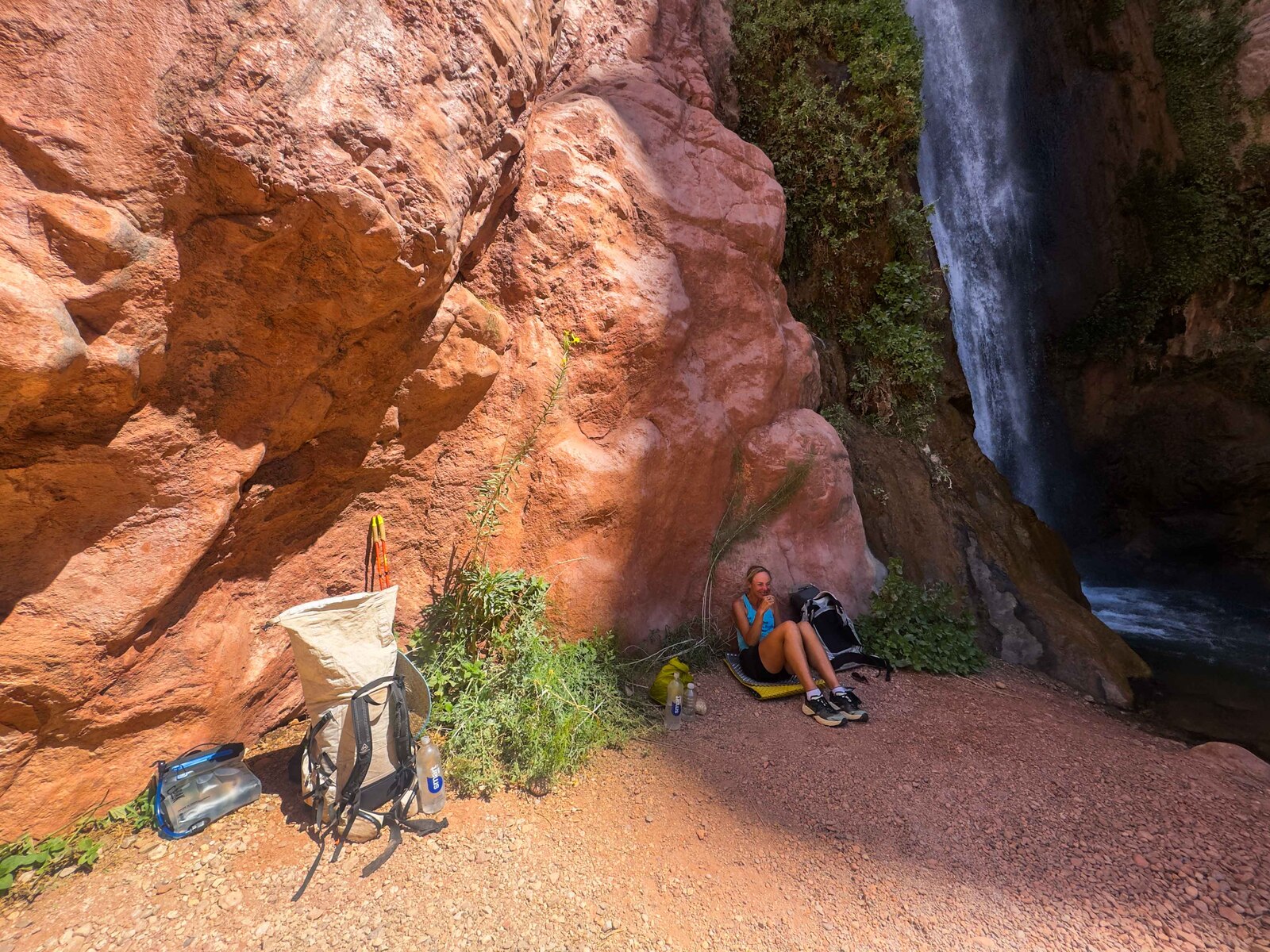
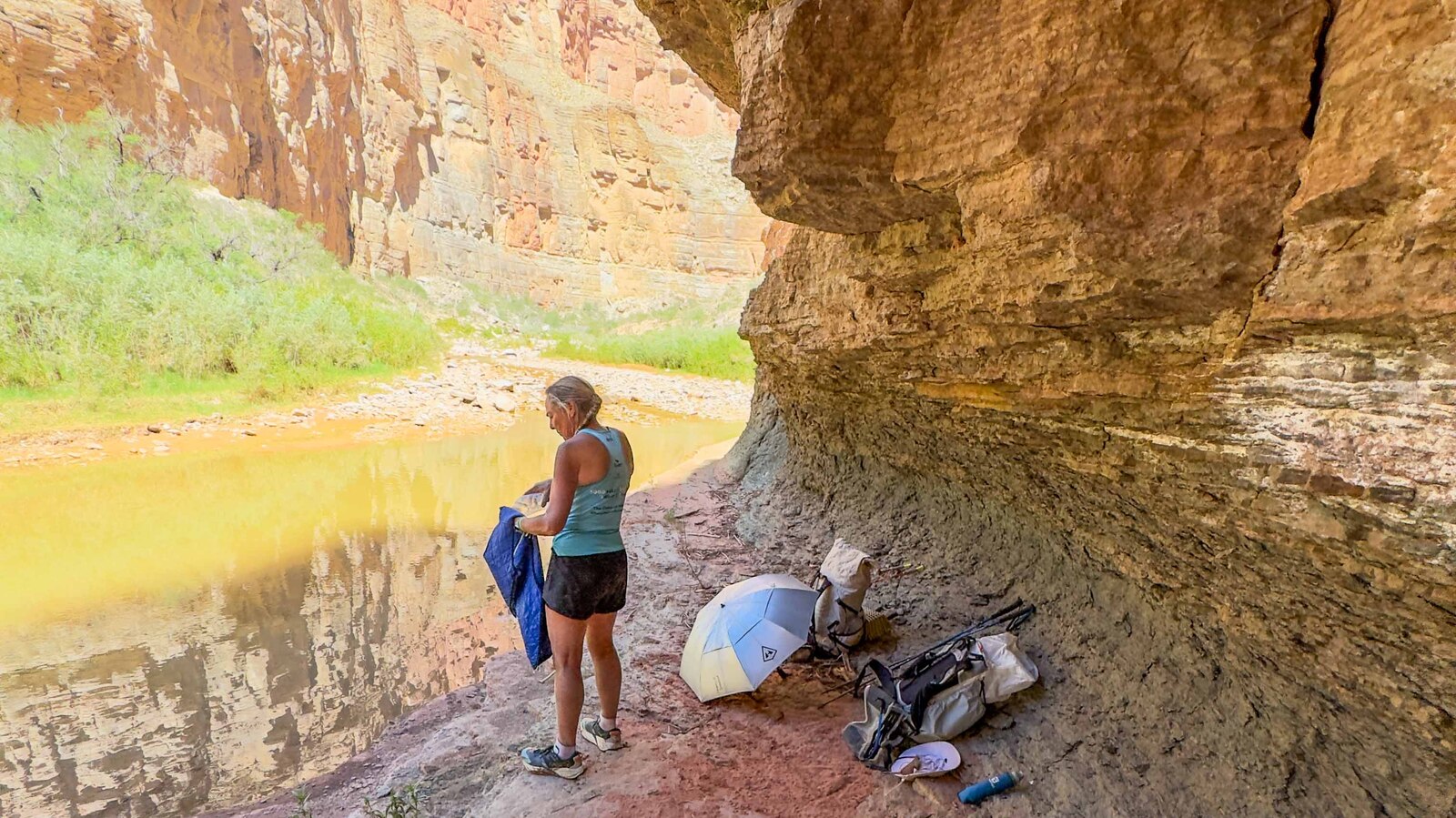
The answers to this challenge looked like paranoia. I hauled up to 9 liters of water per person through dry stretches of about 12 miles — terrain I would normally cross on 2 or 3 liters. I mandated that we deployed cooling vests in the dark, hours before they felt necessary. Long sleeves whenever we were exposed to direct sunlight. Sun umbrellas. Aggressive, deliberate soaking at every water contact — sitting in the river and chilling ourselves down even when the prolonged immersion made us shiver, because the only move that works in an air fryer like the Grand Canyon in August is to bank margin before you need it.
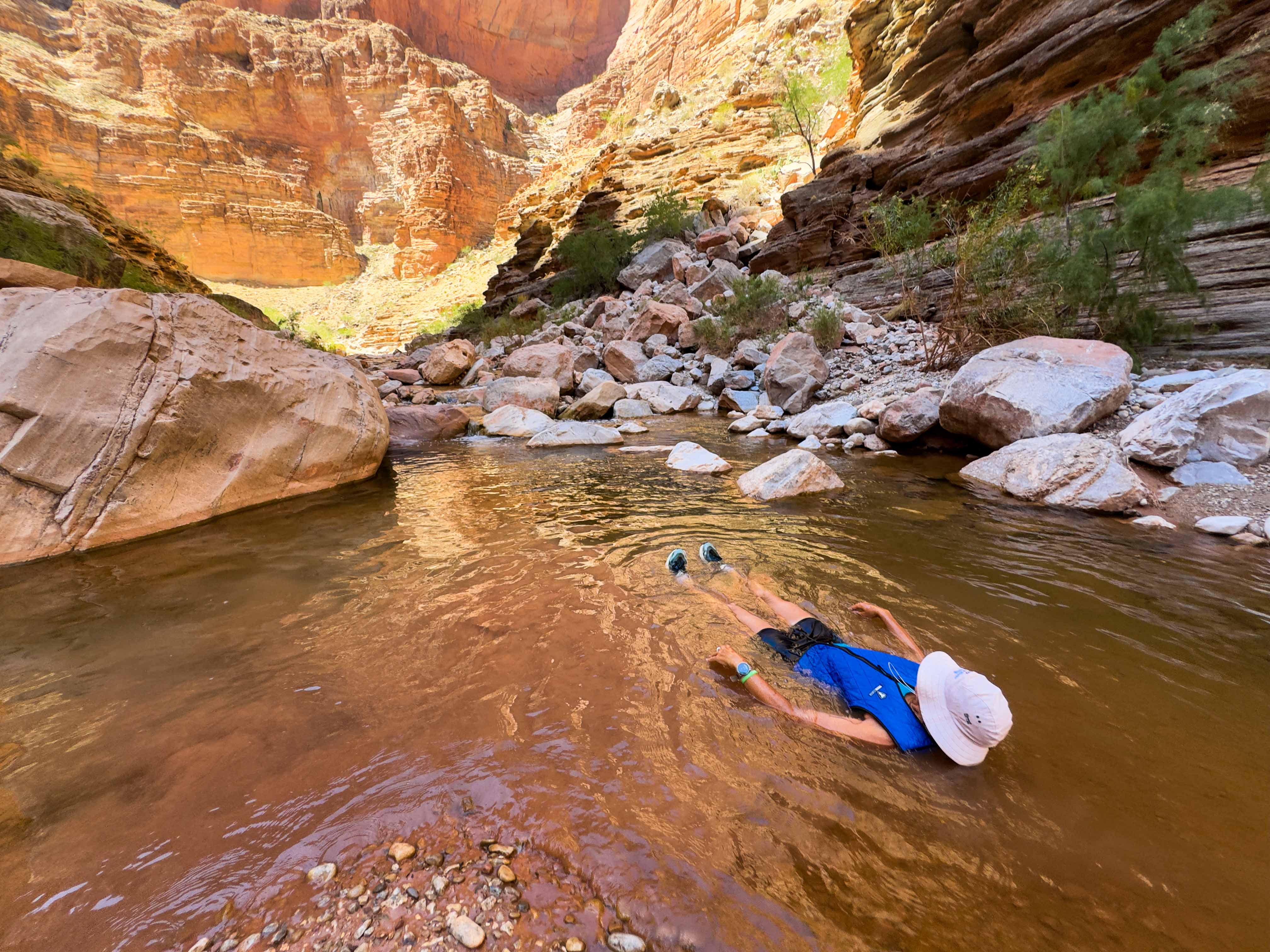
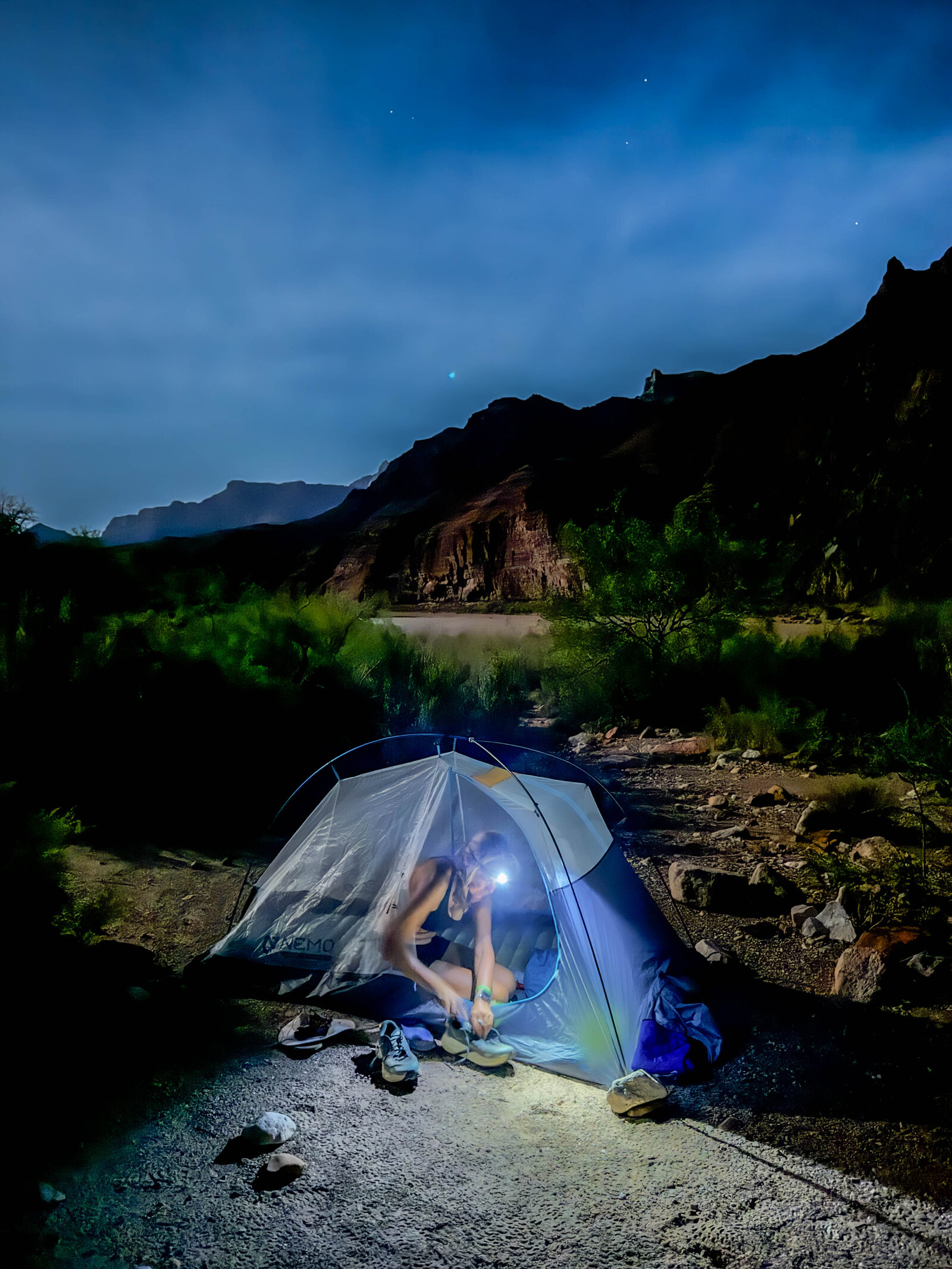
The execution was its own discipline. Almost every night we were up and moving between midnight and two in the morning — we rarely slept past 1 am — because the miles had to happen before sunrise. The moment the summer sun clears the rim in the Grand Canyon, the inner gorge goes from a warm summer night to an oven: high 80°s to 115° in what feels like minutes, with the radiant load spiking toward 150°. We managed heart rates as carefully as pace, because a fully deployed metabolism is its own furnace. And we ate on a schedule, whether we felt like it or not. Everyone understands drinking in the heat; almost nobody understands that eating is heat management too — the body you are trying to cool runs on fuel and without fuel none of the systems work.
Here is the honest accounting: we lived in the orange band the whole time we were below the rim. Eight days of it. Never green — green is not on offer in the inner canyon in July. But: we were never in the red, and I daresay never even in deep orange. We held ourselves somewhere between green-orange and light orange, day after day, through a constant negotiation between making progress and banking safety margin.
None of our strategic risk management approach was for the day we were actually having. All of it was for the day we might have.
The day I let my guard down
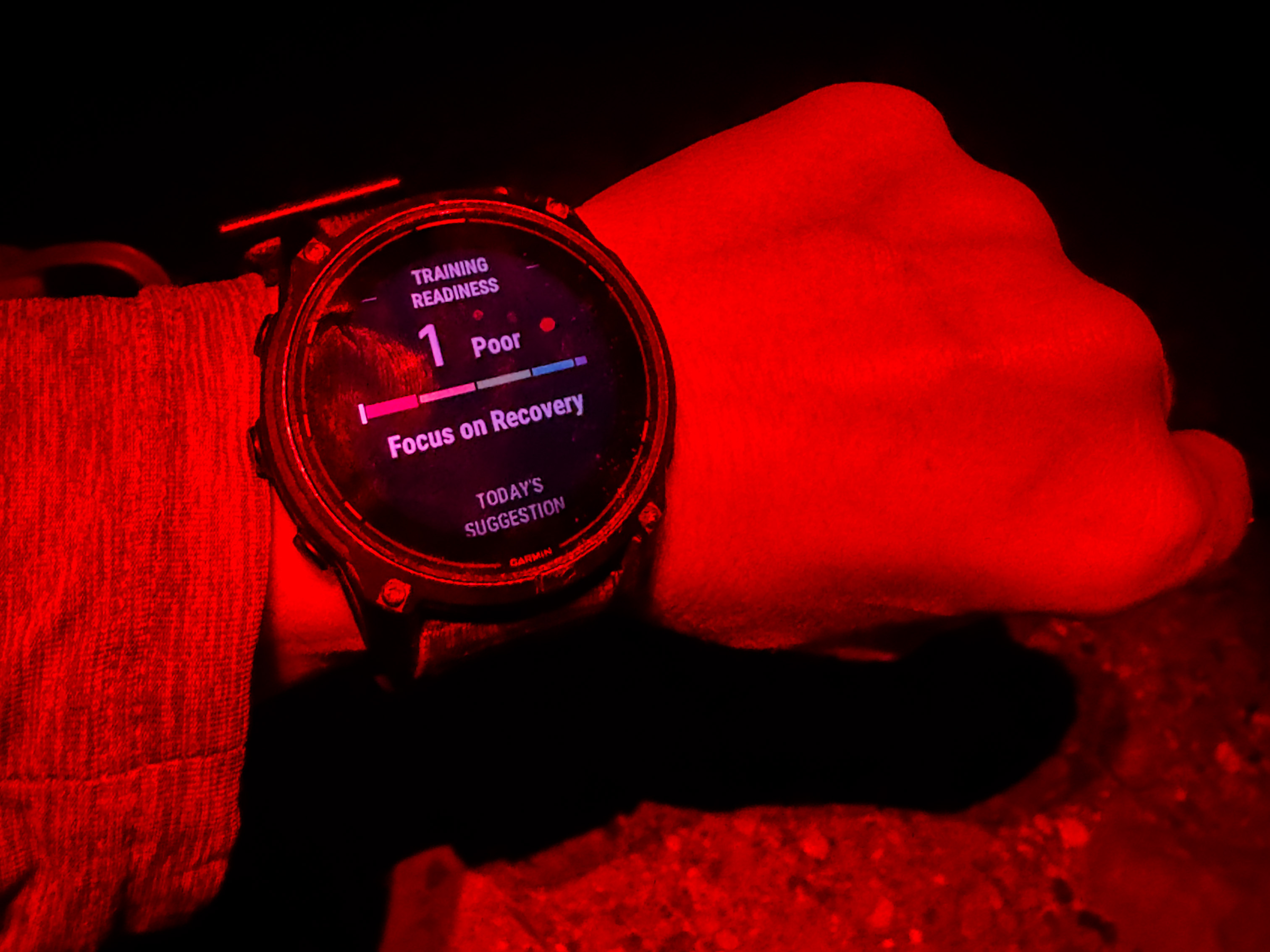
The closest we came to trouble, ironically, was the day the walking stopped.
The Little Colorado was in flood, and getting across it and the main stem of the Colorado meant hitching rides with rafters. Physically, these were some of the easiest hours of the entire traverse — sitting on a boat, following an actual full night of sleep (since rafters travel in daytime). But I let my guard down. I hadn't set us up for it. We ended up on two separate rafts, and Mina spent two, maybe three hours in full sun with no shade umbrella, barely half a liter of water, no snacks, no cooling vest, and none of the proactive heat avoidance strategies that had carried us that far. She came off the river with real heat stress — still well short of heat exhaustion, but it was the most exposed that either of us got in those eight days below the rim.
Sit with that for a second, because it is the whole thesis in miniature. Eight days of brutal terrain, managed inside a safe band. The sharpest edge we found was on a boat ride. Strategic risk does not care that the hard part is over; the system has to be running through the hard AND the easy bits, or all of it derails. For three hours, because I relaxed, our system nearly got derailed.
Recourse
There is a second principle underneath all of this, and it might be the more important one.
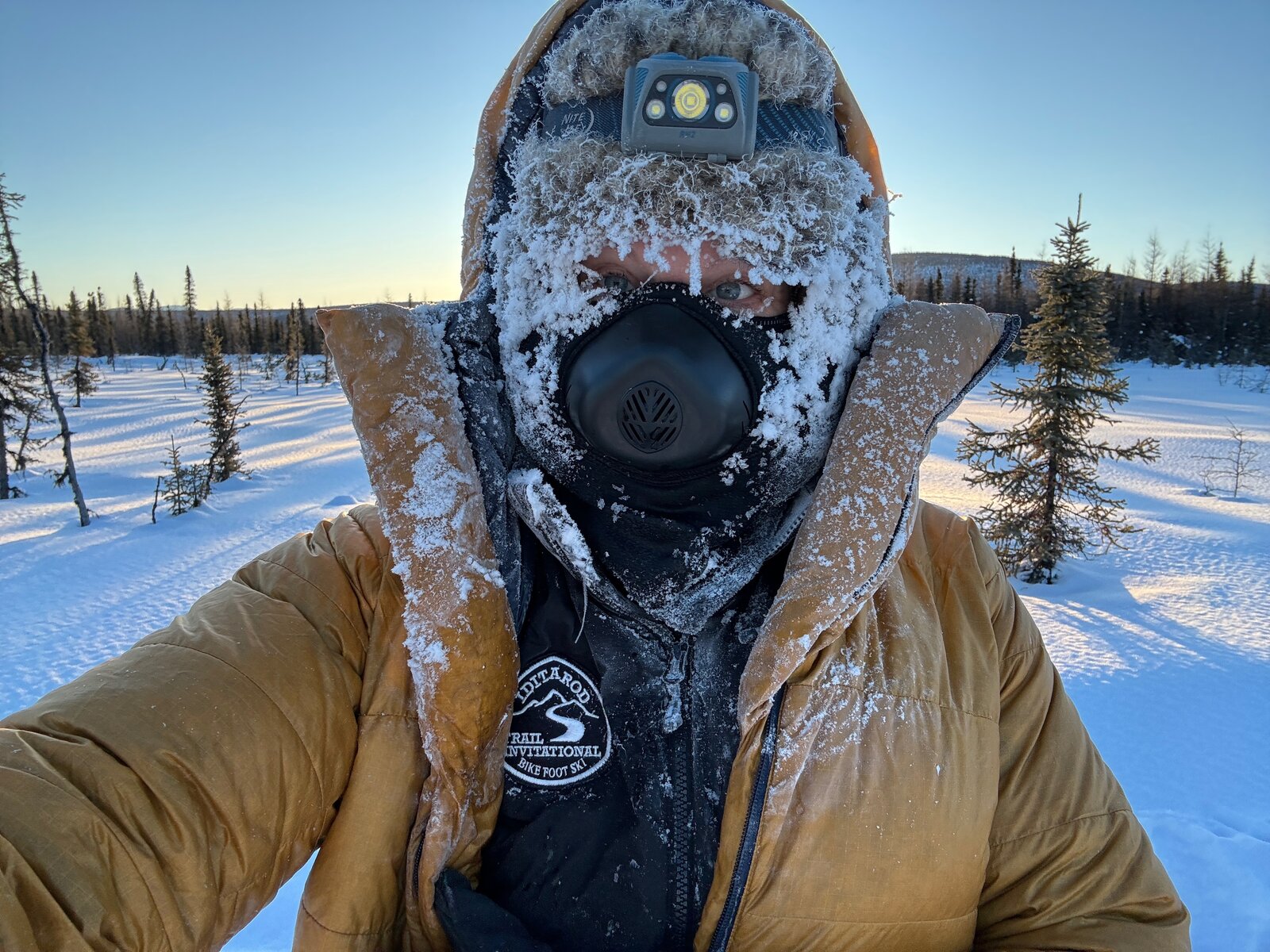
When I raced the 1,000-mile Iditarod Trail through the Alaskan winter, I never needed to know that I could finish safely. I only needed to know that I could do the next few miles safely — and that if conditions turned, I still had options. An option to stop, an option to turn around. And if I couldn't turn around: an option to dig in, build shelter, and wait it out. Just like in the caves of Vietnam, there is no cavalry in the Alaskan interior — the weather and the distances mean you cannot bet on a helicopter the way people do in the Alps. Recourse had to mean things I could do myself. As long as some form of it existed, I could keep making forward bets with limited downside.
I know exactly when I learned this, because I learned it by falling into the gap. In early 2017 I ran from base camp to the summit of Aconcagua for my first speed record, and I paced it like an acute problem: one push, all out, get it done. I tagged the summit believing I had gas left in the tank — and on the way down discovered I had nothing. I couldn't breathe; I took dexamethasone. I was so slow and so depleted that I called Libby, my friend and partner on the mountain, to come up and walk me down, because I truly wasn't sure that I would get myself off the mountain safely. The record was real. So was the lesson: I had treated a strategic problem — a very long day at altitude with the summit at its midpoint — like an acute one, and spent to the redline with half the mountain still to go. The summit is never the finish line. It is the farthest point from safety.
There is a second way to fall into the gap: recourse has to be real, not assumed. On day six of the Iditarod Trail Invitational, crossing the Alaska Range in a blizzard with the windchill pushing fifty-five below, I let myself run colder and deeper into the hole than I ever normally would — because I knew my expedition down jacket was stowed in my pack, ready to catch me on the far side of the pass. Except it wasn't. When I finally stopped and dug for my warmest layer, it was gone — last seen eighteen miles and a mountain pass behind me. The margin that I had been spending against it was suddenly a story I had told myself. What saved me was the recourse that actually existed: a bivy, a sleeping bag rated to -40°, cold food eaten inside it, and a long, humbling wait for enough daylight and regained strength to move again. I made the next checkpoint twenty minutes before the cutoff, and later wrote the whole misadventure up as "Dancing with the Unknown" for Elevation Outdoors. The lesson cost me one very cold night and a bit of skin on one of my fingertips (I developed frostbite that night), but it could have cost everything: because recourse that you haven't verified is not recourse — it is a bedtime story.
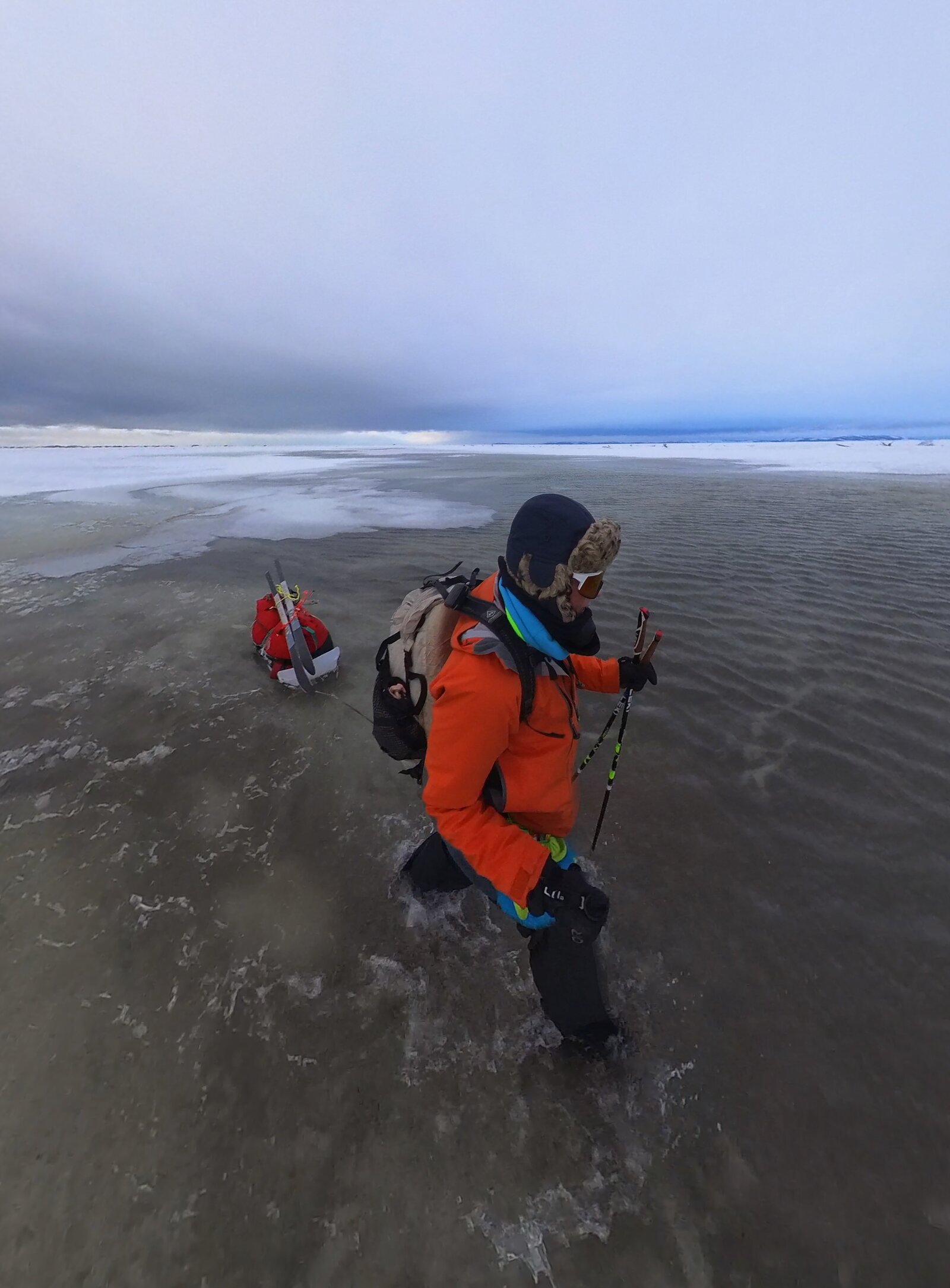
Here's another case in point: the scariest stretch of the Iditarod was not the coldest one. It was the Norton Sound: thirty-some miles across sea ice, where the hunker-down option simply does not exist. You cannot dig in on the sea ice and call it safe. The mental backstop I lean on everywhere else was gone, and every mile out was a mile of mounting commitment — because I didn't know what was ahead. Overflow, open water, a drowned trail could have shut me down at any point. At 26 miles in, the far shore was closer than the one I'd left; but I still had no idea if the trail would actually connect to the far shore, and a forced retreat would have meant 26 miles back across the ice to my last point of safety. In the end, nothing went wrong out there (though I did have to wade through knee deep overflow for — literally — the final 25 yards before I reached the safety of the far shore; imagine what it would have been like if that overflow had extended to 250 yards, or to a quarter mile…). But I have rarely felt more exposed, before or since, than in the middle of that crossing — not because the conditions were the worst I've faced, but because my recourse had been taken from me.
Recourse — that is the test I run before every strategic risk I take, and it is embarrassingly simple. What is the worst that could happen? The answer is never allowed to be "you die." The worst acceptable answer is: you don't get to finish what you set out to do — but you can manage the crisis, keep everyone safe, and walk out. That is my recourse.
In the Canyon, that answer was: we can always find or build shade, hunker down with enough water to make the sauna of 150° radiant temperatures marginally tolerable for several hours, and survive peak heat until nightfall. On the ice, for thirty miles, there was no such answer, and I have carried the feeling of that gap with me ever since.
A confession
Here is something that took me years to admit cheerfully: the same wiring that makes me good at strategic risk makes me mediocre — honestly, kind of crap — at acute risk.
Acute situations are often solved by commitment. You punch through at 95, 98, 100 percent, and the willingness to spend everything is precisely what gets you out the other side. Momentum sports run on that willingness. I don't have it. I never want to be at 100%; I want my margin, my reversibility, my mental trapdoor of knowing I can downclimb, hunker down, or simply stop. Which is why I am an awful lead climber and likely always will be. For a long time that felt like a deficiency. Eventually I understood it is just a specialization — and I noticed that the risks most likely to actually kill me were the ones my wiring happens to be built for.
What this has to do with you, life, and business
More than you'd like, probably.
Years before any of this, in my consulting days, I worked a case that I now recognize as a heat injury. The client had been hammered by the recession: revenue dropped, they laid off a chunk of the workforce, and revenue eventually recovered. They never rehired. On paper it looked like the win of the decade — same revenue, smaller team, doing more with less. Except profitability was atrocious, and nobody could figure out why.
The answer was utilization. The organization had gone from running at roughly 80 percent to running at 98% — and at 98%, everything that doesn't show up on a utilization dashboard breaks: burnout, turnover, rework, quality failures, the senior people (and unhappy customers!) that start heading for the exits. They had pushed the whole company out of the green band and pinned it against the redline, and they had done it without a single alarming moment along the way. Nothing about month one hurt. There was no moment anyone could point to and say: that's where it went wrong.
That is the eighty-five percent rule wearing a lanyard. The same three lessons I carry through the mountains apply directly to business and to life:
The loudest risk is rarely the biggest one. Organizations are wired to manage acute risk — the outage, the lawsuit, the deal that dies in a day. Those failures are dramatic and attributable, so they get the war rooms. But the risks that actually kill companies are strategic: burn rate, technical debt, a culture quietly curdling, the market drifting away from you, everything running through one irreplaceable person. These loads compound in silence, and by the time they announce themselves you are already deep in the hole.
Your redline depends on your rescue. A large company brushing 100% — of cash, of people, of leadership attention — has front-country options: credit lines, hiring pipelines, time. A startup or a small business is in the backcountry, and backcountry rules apply: the resources you'd need to recover from hitting the wall are the ones you burned getting there. If no one is coming to bail you out, 85% is your redline — and you have to hold it while everything feels fine, which is precisely when nobody wants to hear it. There is no toughing out compounding load. Cool down before you're hot.
Never bet the recourse. The move I watch for — in the mountains and in board rooms — is the one that takes your options off the table. Most commitments should be Iditarod miles: you don't need to see the finish, you need to know the next stretch is survivable and the retreat still exists. Then there are the Norton Sounds — the irreversible bets, the sea-ice crossings where hunkering down stops being an option. Sometimes you take them anyway; I did. But you should feel the difference in your gut before you step onto the ice. And audit your safety nets honestly: a rescue you would never actually call — the acquirer you'd never sell to, the bridge round you'd never take — is not recourse. Neither is the one you never checked on: the backup that has never been restored, the puffy jacket that is no longer in the sled. Plan as if they do not exist.
Why I keep going back
Here is the part I don't say often enough: I love this. I love strategic risk management. Why? Acute risk delivers adrenaline, and adrenaline is cheap. Strategic risk demands something better — it demands days of sustained judgment, a body used as an instrument, and the discipline to act on consequences you cannot yet feel. It is the most demanding work I know, and the most engaging, and it is the thread that runs through everything I do, from speed records at altitude to guiding teams through terrain like Mina's to the rooms where I get asked to explain how any of this maps onto running an organization.
For what it's worth: as a speaker I've learned over time that the acute stories are the ones people request — but the strategic ones are the ones they write down.
Mina walked out of the Grand Canyon on August 5. A few days later, her social media manager asked me — in a hopeful manner, the way you tee up good content — to talk about the closest Mina or I came to heat exhaustion down there.
I had to disappoint her. Eight days below the rim, in peak summer, under an extreme heat warning — and the honest answer is that we never got close. I am prouder of that than of almost anything I've done out there, and it is the only reason the whole thing worked at all.
The best story I have from those eight days is that there isn't one. It took everything I know to make it that boring.